

Introduction
DALI (Digital Addressable Lighting Interface) has been used in lighting control systems for many years. More recently, DALI-2 has emerged as the next evolution of the standard.
While the naming suggests a simple upgrade, the differences between DALI and DALI-2 are often misunderstood.
DALI-2 is not a new protocol. It is a refinement of the original DALI standard, focused on improving interoperability, consistency, and the scope of devices that can operate within a standardised DALI system.
What is DALI?
DALI is defined under IEC 62386 and provides a standardised method of communication between lighting control devices such as drivers and controllers.
In its original form, DALI was used primarily for control gear, particularly lighting drivers. While it allowed devices from different manufacturers to communicate using a common protocol, compliance was largely based on manufacturer self-declaration.
In practice, this led to inconsistencies in implementation and, in some cases, interoperability issues between products from different suppliers.
What is DALI-2?
DALI-2 builds on the original DALI standard by introducing formal certification and expanding the scope of the system.
It remains based on IEC 62386, but introduces tighter requirements for how devices are implemented and tested.
The key difference is that DALI-2 devices are independently tested and certified, rather than relying on manufacturer self-declaration.
Key Differences Between DALI and DALI-2
1. Certification and Compliance
The most significant change in DALI-2 is the move to formal certification through the DALI Alliance (DiiA).
- DALI: compliance was self-declared by manufacturers
- DALI-2: devices are independently tested and certified
This reduces the risk of compatibility issues and gives designers and specifiers greater confidence when combining products from different manufacturers.
2. More Than Just Drivers on the Bus
One of the most important practical differences is that DALI-2 supports a much broader range of certified devices on the DALI bus itself.
Original DALI was largely centred around control gear such as drivers. DALI-2 expands the standardised ecosystem to include:
- input devices such as switches and sensors
- application controllers
- control accessories such as relays, phase dimmers, and PWM interfaces
- emergency lighting devices and fittings
This is a major distinction. In many traditional networked lighting control systems, DALI may still be used for luminaires, but switches, sensors, and other control devices sit on a separate proprietary network or dedicated control cabling system.

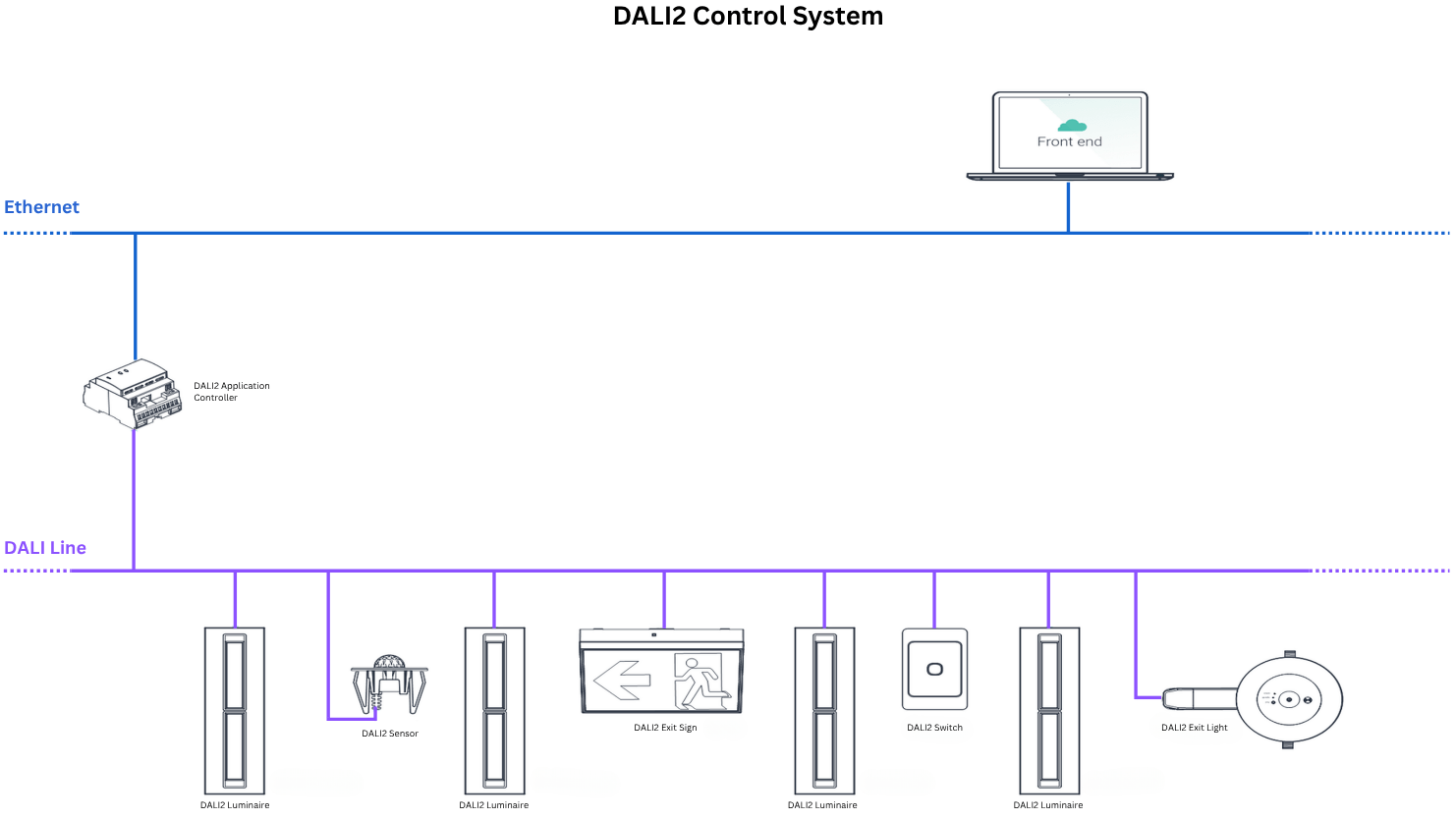
With DALI-2, a much more complete lighting control architecture can operate within the same DALI ecosystem, using standardised bus communication across a wider range of devices.
3. Improved Interoperability
While DALI was always intended to be interoperable, differences in implementation often led to inconsistent behaviour between manufacturers.
DALI-2 addresses this by enforcing stricter compliance requirements, resulting in more predictable interaction between drivers, sensors, switches, and controllers.
In practice, this means fewer commissioning issues and more reliable system performance.
4. Standardised Device Behaviour
DALI-2 defines more consistent behaviour across device types, reducing ambiguity in how commands are interpreted and executed.
This is particularly important in larger systems where multiple device types are expected to work together reliably.
What Has Not Changed
Despite these improvements, the core communication method remains the same.
- the two-wire bus architecture remains in place
- addressing principles are still familiar
- the underlying protocol remains based on IEC 62386
In other words, DALI-2 is not a replacement for DALI in the sense of a completely new system. It is a more mature and more rigorously defined version of it.
What This Means in Practice
For designers and specifiers, the difference between DALI and DALI-2 is less about a dramatic change in protocol and more about system confidence.
DALI-2 makes it possible to build a more complete and more standardised lighting control system using certified devices across drivers, sensors, switches, accessories, and emergency lighting.
This can reduce the need for separate proprietary control networks and help simplify system architecture, commissioning, and future maintenance.
Common Misconceptions
- DALI-2 is a completely new system
It is not. It is an evolution of the existing DALI standard. - DALI-2 is only about certified drivers
No. One of the most important developments is the broader range of certified device types that can now form part of the DALI-2 ecosystem. - DALI is obsolete
DALI is still widely used, but DALI-2 is now the preferred approach for new systems where interoperability and long-term reliability matter.
A Broader DALI-2 Ecosystem
As DALI-2 adoption has matured, the range of supported products has expanded significantly beyond drivers alone.
Through our LumiLink range, we supply a large range of DALI-2 accessories such as 0-10V, phase dimmers, PWM interfaces and much more, while our EMEGY range includes DALI-2 emergency lighting solutions. This broader ecosystem is one of the reasons DALI-2 is now such a strong platform for complete lighting control system design.
Conclusion
DALI-2 represents a significant step forward from original DALI, not because it changes the underlying bus architecture, but because it improves interoperability and broadens the scope of standardised devices that can sit on the system.
The move from self-declared compliance to certified interoperability, combined with the inclusion of sensors, switches, accessories, controllers, and emergency devices within the DALI-2 ecosystem, is what really sets it apart.
For designers and specifiers, that means greater confidence in system performance and a clearer pathway to delivering complete, coordinated lighting control systems.
Need help selecting or designing a DALI-2 system?
Our team can assist with system architecture, product selection, and ensuring your lighting control system is robust and fit for purpose.
Contact Us
Smartscape are proud members of the DALI Alliance
